Parents Guide to the SAT
Colleges are requiring the SAT again, and the research is clear: a strong score predicts college success better than grades, can offset a lower GPA, and unlocks scholarships worth tens of thousands of dollars. The best part? Unlike GPA, the SAT is coachable — and Test Ninjas is the system that raises it.
Colleges Are Requiring the SAT Again
For a few years, "test-optional" made the SAT feel optional. That era is ending. Beginning with the 2025 admissions cycle, a wave of the most selective universities reinstated the SAT/ACT requirement — and more join every year. Test-optional never meant test-irrelevant: even at schools that still don't require scores, applicants who submit strong ones are admitted at higher rates.
| University | SAT/ACT required again |
|---|---|
| Dartmouth, Yale, Harvard, Brown | Class of 2029 (Fall 2025) |
| MIT, Caltech, Stanford | Required for 2025–2026 |
| Georgetown, University of Pennsylvania | 2025 / 2026 cycle |
| UT Austin, University of Florida, Purdue | Public flagships, 2025–2026 |
| Cornell, Princeton, Columbia | Phasing back in (through 2027) |
Sources: Dartmouth, Stanford, Caltech, UT Austin, Princeton.
The Most Important Academic Signal
Why are top schools so confident bringing the test back? Because their own data — and a landmark 2024 study from Opportunity Insights (the Harvard-based research group led by Raj Chetty) — shows the SAT is the strongest single predictor of how a student will actually perform in college.
In the Opportunity Insights study of Ivy-Plus colleges, SAT scores were roughly four times more predictive of first-year college GPA than high school GPA. A jump from 1200 to 1600 corresponded to a 0.43-point higher college GPA, while a 3.2-to-4.0 high-school-GPA difference predicted only about 0.1 points. Dartmouth's internal analysis reached the same conclusion — the SAT, combined with high school performance, was the strongest predictor of success in its curriculum (Dartmouth, 2024).
The University of Texas at Austin found the same thing in its own students: those who submitted scores averaged 0.86 grade points higher their first semester and were 55% less likely to fall below a 2.0 — which is exactly why it brought the requirement back (UT Austin, 2024).
How a Strong SAT Offsets a Lower GPA
Here's the part most parents don't realize: a great SAT score can compensate for a transcript that isn't perfect. The reason is grade inflation. The average high school GPA climbed from 3.22 in 2010 to 3.39 in 2021 — even as average ACT scores fell from 21 to 20 over the same period (Hechinger Report / ACT). When nearly everyone has an A-minus, GPA stops telling admissions officers who is actually prepared.
The SAT solves that problem. It's the one number every applicant earns under identical conditions, immune to your school's grading culture. So when a committee sees a strong score next to a B+ transcript, it reads as clear evidence the student can do the work — and ACT's research confirms high school GPA has become a less reliable predictor of first-year college performance since the pandemic (ACT, 2024).
The Payoff: Admissions & Scholarships
A higher score doesn't just help with admission — it pays cash. Merit scholarships are frequently tied directly to SAT scores: meaningful awards generally open up around a 1200, and 1400+ can unlock full-tuition packages at many universities, plus National Merit recognition through the PSAT.
Test Ninjas premium is $29/month — less than a single hour with most private tutors. Structured prep with regular practice tests typically raises scores 100–200 points. That gain can move a student into a more selective school and trigger merit aid worth thousands to tens of thousands of dollars per year. A few months of focused study is one of the highest-return investments you can make in your child's education.
How Test Ninjas Raises the Score
Raising an SAT score isn't about doing thousands of random questions. It's a simple, repeatable loop — and Test Ninjas is built around it. Diagnose, target, master, repeat.
This is the difference between "studying for the SAT" and a system engineered to raise the score. No guesswork about what to do next — the platform always points to the highest-value skill to work on.
Everything Included
One membership unlocks the entire system — the course, the practice, the analytics, and the explanations behind every question.
| Plan | Price | Best for |
|---|---|---|
| Free account | $0 | Start the course and take a practice test today |
| Premium | $29/month | The full course, 20 practice tests, problem sets & analytics |
Get Started in Minutes
You don't need a complicated plan to begin — just start the loop. Here's the fastest path from today to a higher score:
| Step | What your child does | In Test Ninjas |
|---|---|---|
| 1. Create an account | Sign up free and open the SAT course | Free account, lessons & practice included |
| 2. Take a baseline test | Sit one full-length adaptive test to find the starting score | Adaptive practice test + instant skill report |
| 3. Follow the analytics | Drill the weakest skills 3–4×/week | Targeted lessons + problem sets per skill |
| 4. Re-test monthly | Confirm gains and reset targets | Progress tracking over time |
| Final week | Light review — build confidence, don't cram | Quick daily continuous-practice sessions |
Supporting Your Child (Without the Stress)
Your involvement matters — but how you engage shapes their confidence. Set the study schedule together and check in weekly rather than daily; students perform best when they feel supported, not surveilled. Focus on the overall trend, not any single practice score, and keep the SAT in proportion with grades, activities, and rest. Short, consistent sessions — even 30–45 minutes a few times a week — beat weekend cram marathons, which is exactly what the platform's daily continuous-practice mode is built for.
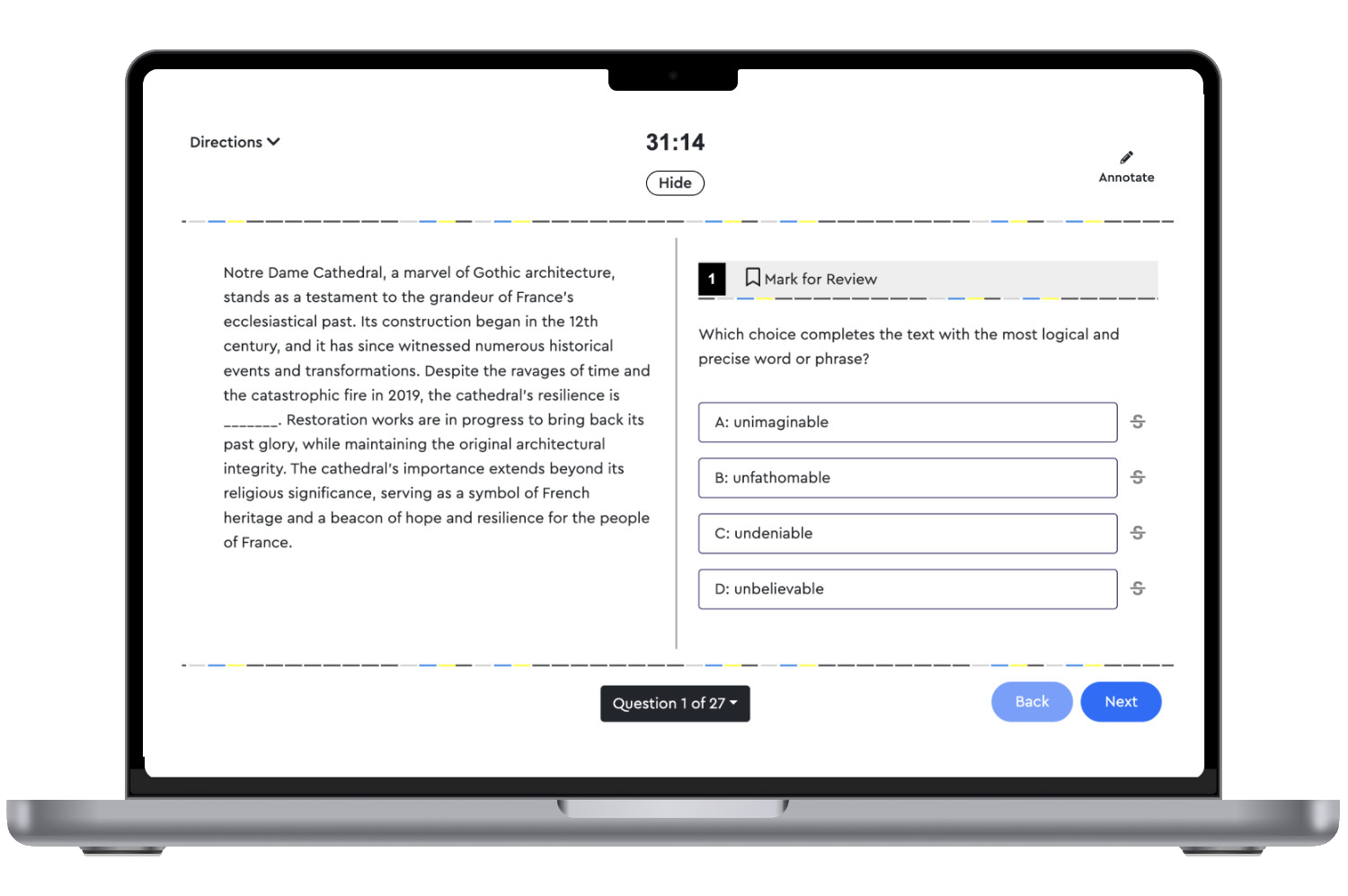
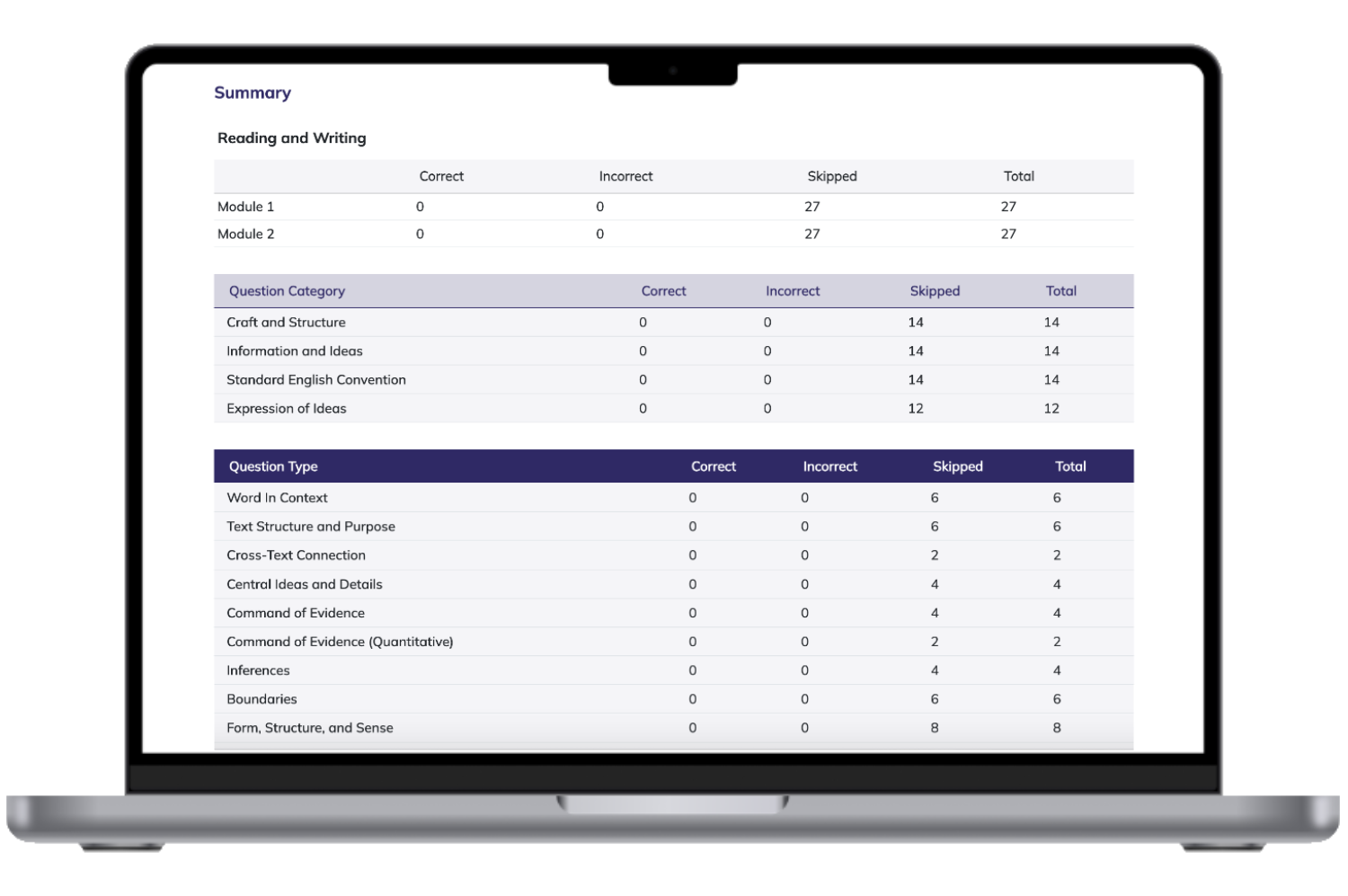
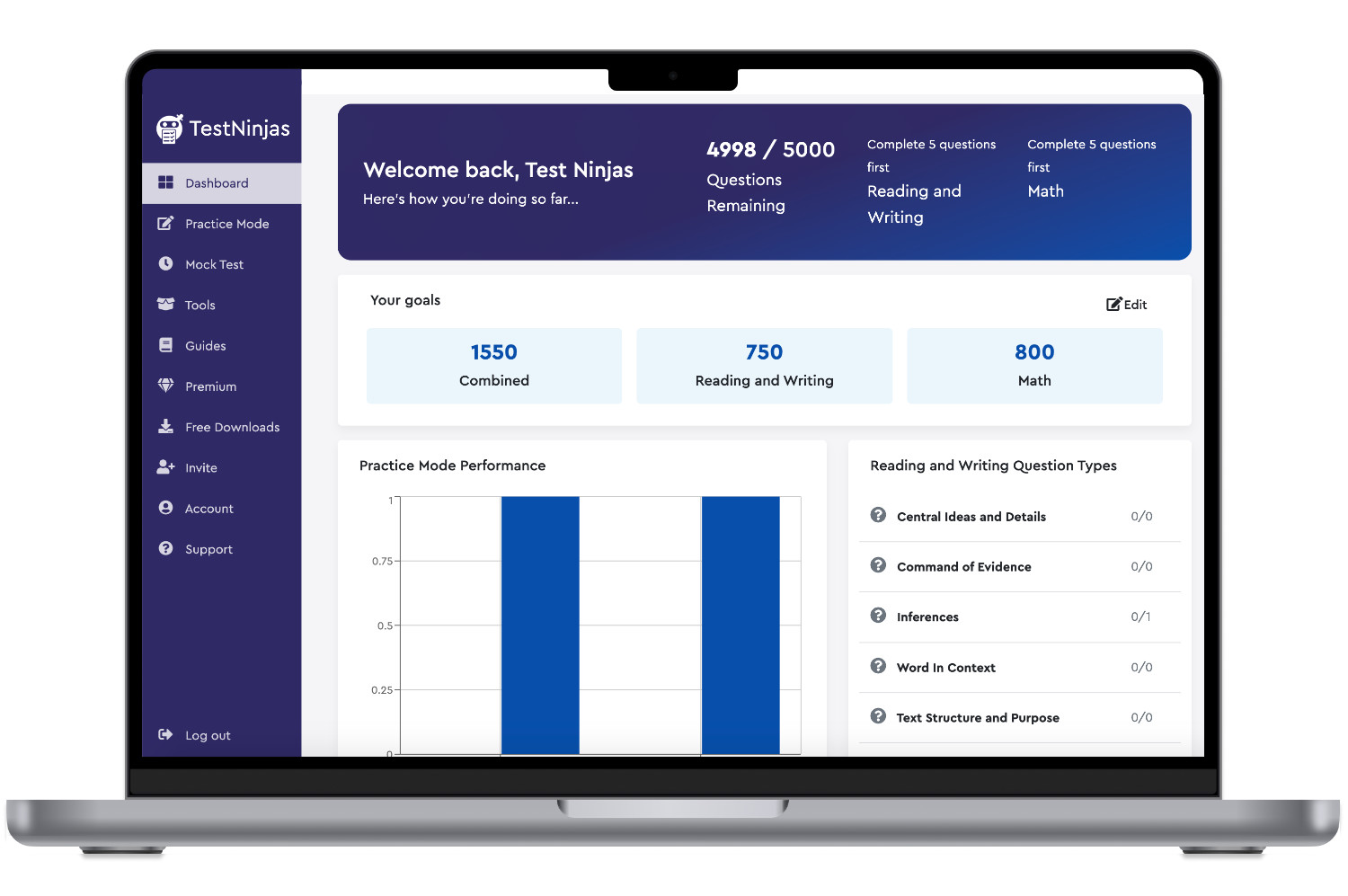
Inside the SAT platform.
A look at the practice tests, score reports, and dashboard your child works in — built to feel exactly like test day.
Trusted by students and the teachers who guide them.
Real results from students, and the tutors and teachers who use Test Ninjas with their classes every day.
The practice tests felt just like Bluebook, so nothing on test day surprised me. I scored almost exactly what I was getting at home.
The plan told me what to study each day instead of me guessing. Most of what I kept missing was algebra and comma rules.
The science lessons gave me a way to attack the long passages instead of just reading and hoping. It went from my worst section to my best.
The practice tests actually made me feel the time pressure in reading. After a few weeks I stopped running out of time on the last passage.
The English questions actually explain the grammar rules the test keeps using. English ended up being my biggest jump.
Test Ninjas has made a real difference for my students. The platform is outstanding, and the adaptive tests really help them get used to what they'll see on test day.

Since adopting the platform, our students have improved by 150+ points on average. The targeted modules and realistic tests made a huge difference.