Parents Guide to the ACT
Colleges are requiring the ACT again, and the stakes are high: at top schools a strong score is the difference between a maybe and an admit, and at state flagships it can earn a near-full or full ride automatically. The best part? Unlike GPA, the ACT is coachable — and Test Ninjas is the system built to raise it.
Colleges Are Requiring Tests Again
For a few years, "test-optional" made the ACT feel optional. That era is ending. Beginning with the 2025 admissions cycle, a wave of the most selective universities reinstated the SAT/ACT requirement — and the ACT is accepted everywhere the SAT is. Test-optional never meant test-irrelevant: even at schools that still don't require scores, applicants who submit strong ones are admitted at higher rates.
| University | SAT/ACT required again |
|---|---|
| Dartmouth, Yale, Harvard, Brown | Class of 2029 (Fall 2025) |
| MIT, Caltech, Stanford | Required for 2025–2026 |
| Georgetown, University of Pennsylvania | 2025 / 2026 cycle |
| UT Austin, University of Florida, Purdue | Public flagships, 2025–2026 |
| Cornell, Princeton, Columbia | Phasing back in (through 2027) |
How the 2025–26 Enhanced ACT Works
Before the strategy, the basics — because the ACT itself changed. For 2025–26 the test moved to a shorter, enhanced format: English, Math, and Reading form the required core, and Science is now optional. Scoring is unchanged on the familiar 1–36 scale, and your child's composite is the average of the required sections, rounded to a whole number.
| What | Detail |
|---|---|
| Sections | English, Math, and Reading (required); Science (optional) |
| Scoring | Each section 1–36; composite is their average |
| Format | New shorter enhanced format for 2025–26 |
| Superscoring | Most colleges accept a superscore — best section scores across dates |
| SAT vs. ACT | Colleges accept either equally, so it's worth trying a practice test of each |
What a High ACT Unlocks at Top Schools
At the most selective universities, admitted students cluster in a narrow ACT band. A 34 or higher puts your child in roughly the top 1% of all test-takers — exactly where elite admissions committees expect to see strong applicants.
| University | Admitted middle 50% (ACT) |
|---|---|
| Harvard · MIT · Stanford | 34–36 |
| Duke · Vanderbilt | 34–35 |
| Notre Dame | 33–35 |
| University of Michigan | 31–34 |
Ranges per school class profiles and admissions data (e.g. Vanderbilt Common Data Set, Michigan 2025–26).
From a 30 to a 36: Why a Few Points Change Everything
On the ACT, small point gains move you enormous distances up the national percentile curve — because nearly everyone is bunched together near the top. A handful of points is the difference between "good" and "elite."
A 30 already opens doors. But moving to a 34–36 jumps your child into the top 1%, turning reach schools into realistic targets — and, as the next section shows, it unlocks the largest automatic-scholarship tiers. Those final few points are usually the highest-leverage work your child can do, because the ACT is far more coachable than a multi-year GPA.
Percentiles per ACT national norms — see our ACT score percentiles guide.
The Scholarship Payoff — Including In-State
Here's what most families underestimate: a high ACT doesn't just help with admission — it pays. Many universities award automatic merit scholarships keyed directly to ACT score and GPA — no extra essays, no waiting. And state-funded programs can cover most or all of in-state tuition for a qualifying score.
Automatic merit by score
| University | ACT | Award |
|---|---|---|
| University of Alabama | 32–36 | ~$28,000/yr (≈ $112k over 4 years) |
| University of Alabama | 30–31 | ~$24,000/yr |
| University of Alabama | 29 | ~$15,000/yr |
| Mississippi State (in-state) | 33–36 | ~$10,500/yr |
| UT Knoxville — Volunteer (in-state) | 34–36 | ~$9,000/yr |
Sources: University of Alabama scholarship chart, UT Knoxville.
State-funded programs (in-state value)
| Program | ACT threshold | What it covers |
|---|---|---|
| Florida Bright Futures (Academic Scholars) | 29+ | 100% of in-state tuition |
| Florida Bright Futures (Medallion) | 24+ | 75% of in-state tuition |
| Georgia Zell Miller | 25+ (3.7 GPA) | Full in-state tuition |
| Georgia HOPE | 24+ | Most in-state tuition |
| Tennessee HOPE | 21+ | Tuition at TN public universities |
Sources: Florida Bright Futures, Georgia Student Finance Commission, Tennessee HOPE.
The ROI: A Worthwhile Investment
Test Ninjas is $29/month — less than a single hour with most private ACT tutors. Structured prep with regular practice tests typically raises composites 4–5 points. That gain can move a student into a more selective school and jump them into a higher automatic-scholarship tier worth thousands of dollars a year — sometimes a full in-state ride. A few months of focused work is one of the highest-return investments you can make in your child's education.
The ACT Predicts Success — and Offsets a Lower GPA
Why are top schools so confident bringing the test back? Because their own data — and a landmark study from Opportunity Insights — shows standardized scores are the strongest single predictor of how a student will actually perform in college: about four times more predictive of college GPA than high school grades.
That also means a strong ACT can compensate for a transcript that isn't perfect. Grades have inflated for years — the average high school GPA climbed from 3.22 in 2010 to 3.39 in 2021 even as average ACT scores slipped from 21 to 20 (ACT study, via The 74). When nearly everyone has an A-minus, GPA stops telling admissions officers who is prepared — and the ACT, taken under identical conditions by every applicant, becomes the trustworthy signal.
How Test Ninjas Raises Your Score
Raising an ACT score isn't about doing thousands of random questions. It's a simple, repeatable loop — and Test Ninjas is built around it. Diagnose, target, master, repeat.
This is the difference between "studying for the ACT" and a system engineered to raise the score. No guesswork about what to do next — the platform always points to the highest-value section to work on.
Everything Included
One membership unlocks the entire system — the course, the practice, the analytics, and the explanations behind every question.
| Plan | Price | Best for |
|---|---|---|
| Premium | $29/month | The full course, 10 practice tests, problem sets & analytics |
Get Started in Minutes
You don't need a complicated plan to begin — just start the loop. Here's the fastest path from today to a higher score:
| Step | What your child does | In Test Ninjas |
|---|---|---|
| 1. Create a free account | Sign up and open the ACT course | Free to start |
| 2. Take a baseline test | Sit one full-length test to find the starting composite | Practice test + instant section report |
| 3. Follow the analytics | Drill the weakest section 3–4×/week | Targeted lessons + problem sets per section |
| 4. Re-test monthly | Confirm gains and reset targets | Composite tracking over time |
| Final week | Light review — build confidence, don't cram | Quick daily continuous-practice sessions |
Supporting Your Child (Without the Stress)
Your involvement matters — but how you engage shapes their confidence. Set the study schedule together and check in weekly rather than daily; students perform best when they feel supported, not surveilled. Focus on the overall trend, not any single practice score, and keep the ACT in proportion with grades, activities, and rest. Short, consistent sessions — even 30–45 minutes a few times a week — beat weekend cram marathons, which is exactly what the platform's daily continuous-practice mode is built for.
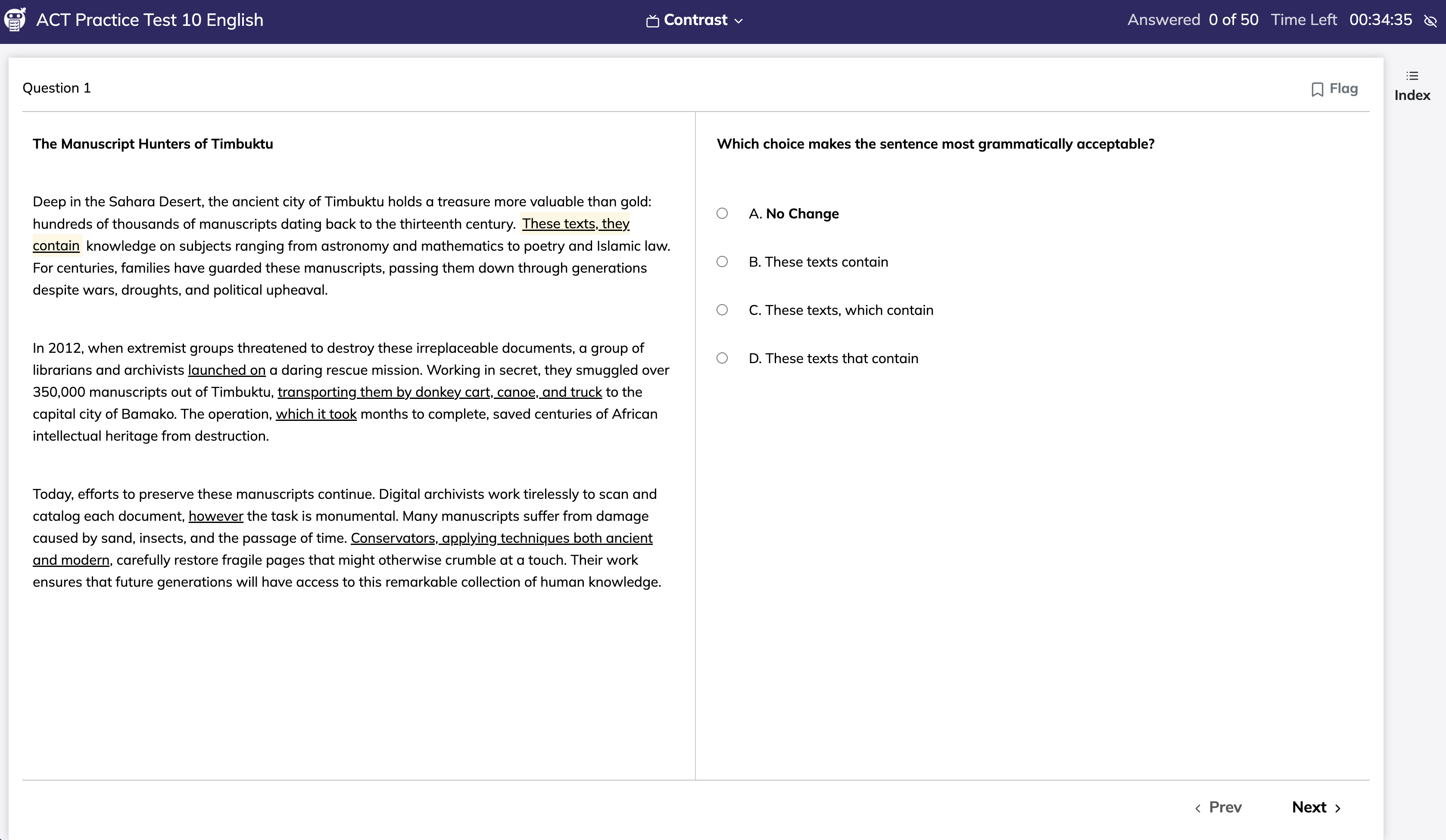
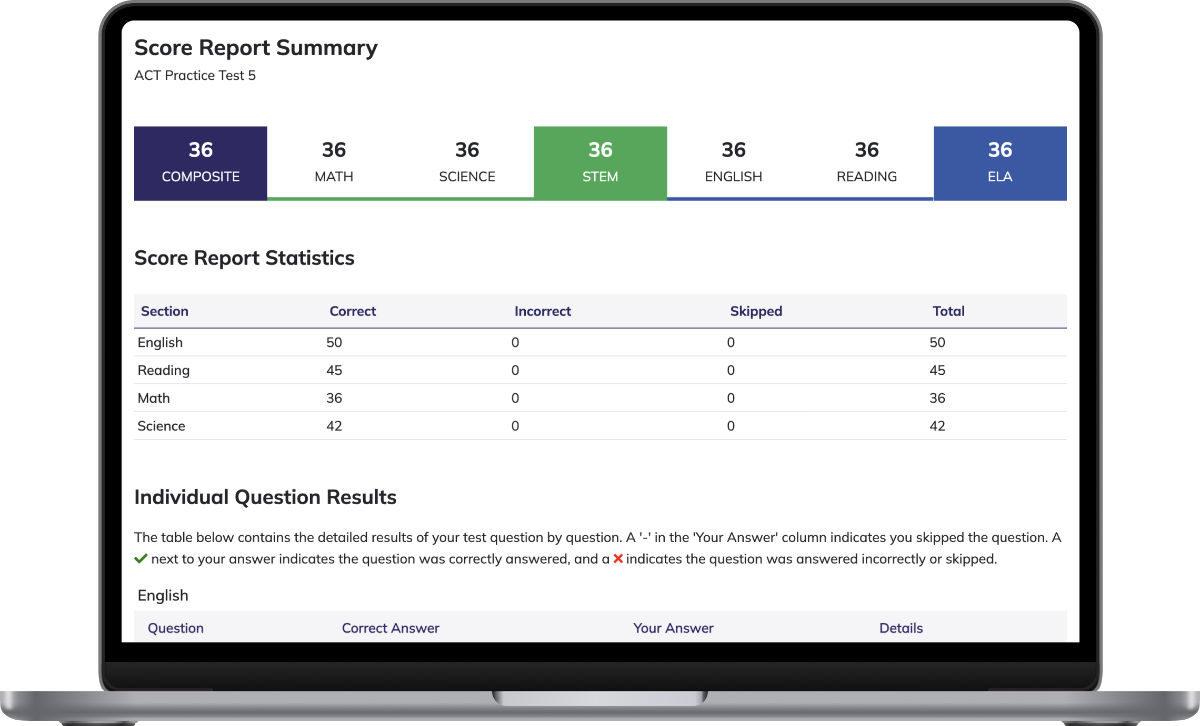
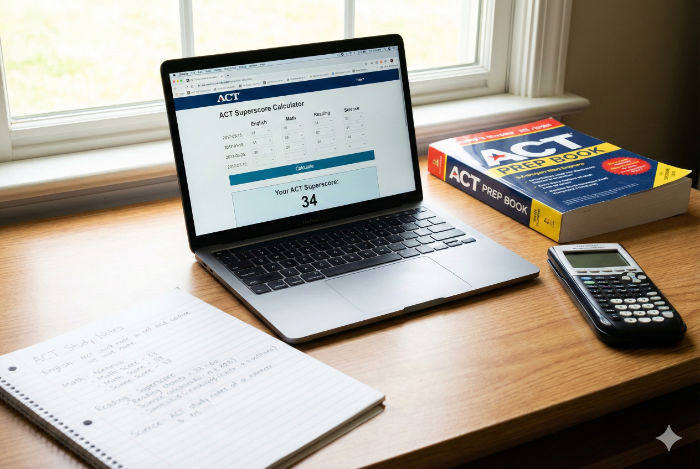
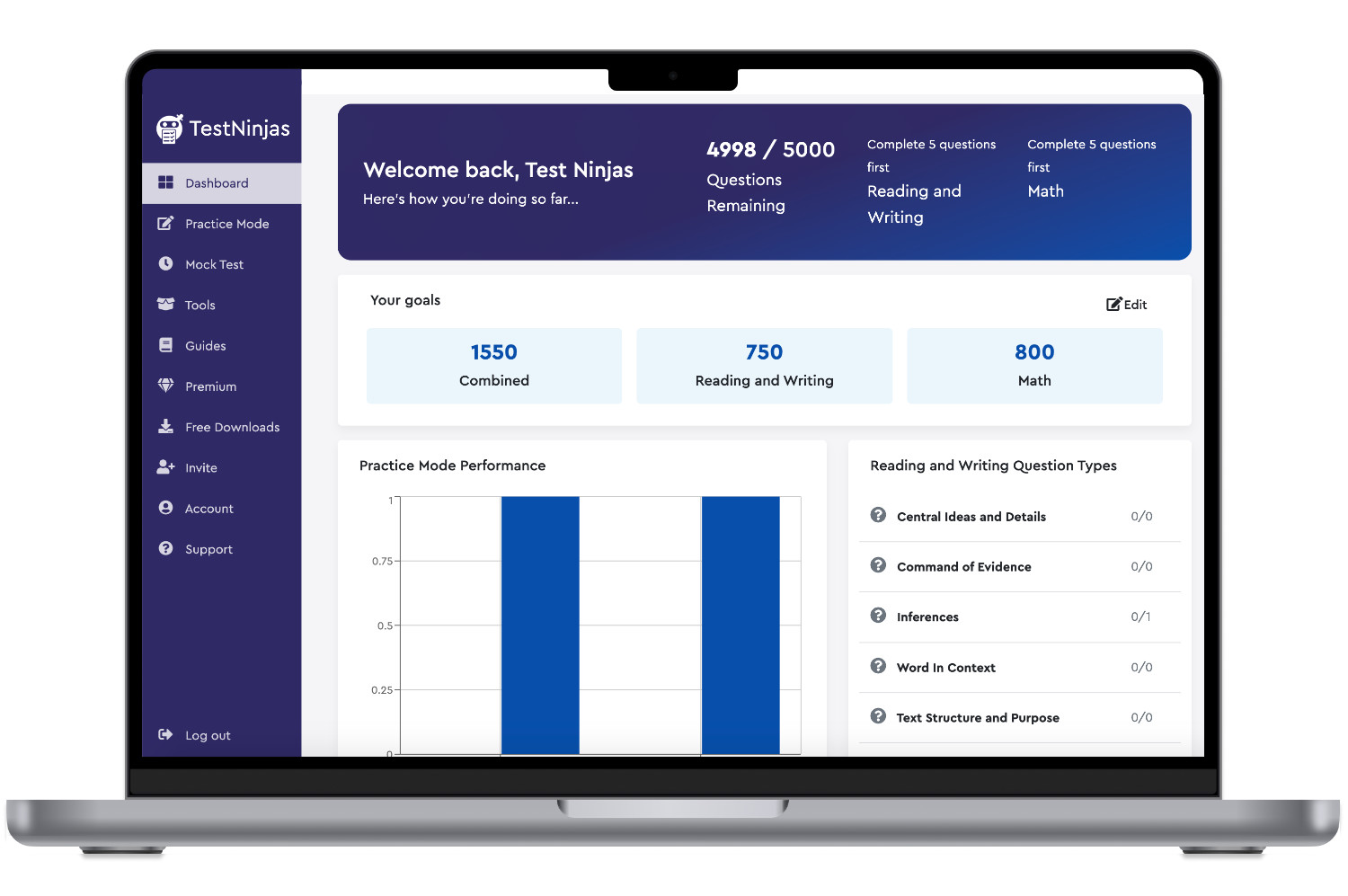
Inside the ACT platform.
Not a stock mockup — the real practice interface, score reports, superscore tools, and dashboard your child works in every day.
Real ACT gains from real students.
Students who raised their ACT with Test Ninjas, and the tutors and teachers who use it with their classes every day.
The practice tests felt just like Bluebook, so nothing on test day surprised me. I scored almost exactly what I was getting at home.
The plan told me what to study each day instead of me guessing. Most of what I kept missing was algebra and comma rules.
The science lessons gave me a way to attack the long passages instead of just reading and hoping. It went from my worst section to my best.
The practice tests actually made me feel the time pressure in reading. After a few weeks I stopped running out of time on the last passage.
The English questions actually explain the grammar rules the test keeps using. English ended up being my biggest jump.
Test Ninjas has made a real difference for my students. The platform is outstanding, and the adaptive tests really help them get used to what they'll see on test day.

Since adopting the platform, our students have improved by 150+ points on average. The targeted modules and realistic tests made a huge difference.